


What’s the Difference Between EAP-TTLS/PAP vs. EAP-TLS?
 Keytos Team |
- Updated: May 10, 2026
Keytos Team |
- Updated: May 10, 2026How to Prevent Credential Compromise with EAP
For the sake of argument, we’re going to assume you’ve landed on this post because the sanctity of your organization’s network security is of supreme importance to you, prompting a quest for fortified defenses. Alternatively, should this subject matter not have previously piqued your interest, allow us to assert the urgency of attending to this matter forthwith.
A recent exposition by Positive Technologies has illuminated a rather alarming vulnerability within the digital “security infrastructure” of modern enterprises: a staggering 93 percent of a company’s digital assets can fall prey to cyber incursions within 48 hours (about 2 days) of an initial attack. This revelation underscores the criticality of “credentials compromise” as a predominant vector for successful intrusions within network defenses. If you’re familiar with the blog, you’re aware that passwords are a problem!
In the quest to safeguard your organization’s WPA2-Enterprise network, the arsenal of protocols at your disposal is vast. Yet, among these, the Extensible Authentication Protocols (EAP) emerge as the preeminent choice for a substantial number of enterprises. Let’s delve into an examination of the two most prevalently employed EAP protocols, aiming to highlight the merits of each and thereby assist you in making an informed selection most befitting your organizational needs.
What is Extensible Authentication Protocol (EAP)?
At its core, the Extensible Authentication Protocol (EAP) represents a framework designed to fortify the communication corridors between a client and server by creating an encryption tunnel for the communication to be encrypted. EAP requires a server with a certificate, and a client that trusts that certificate; usually clients validate that the server certificate was issued by a trusted Root CA and the CN (Common Name) of the server certificate matches what the client expects. This protocol serves as the cornerstone of modern wireless networking, offering a barrier against the multifaceted threats that besiege our organizations in today’s day and age.
Imagine EAP as the protocol framework devices use to authenticate to the network. In the zero-trust world, the most common methods are EAP-TLS and EAP-TTLS/PAP, since they both use a TLS tunnel where messages between your device and the network’s server can be exchanged securely, thanks to some digital trust magic involving certificates. There are a few ways to set up this secure communication and the authentication methods inside the EAP tunnel, but these two are the main characters, so to speak, in the EAP world.
What is EAP-TLS?
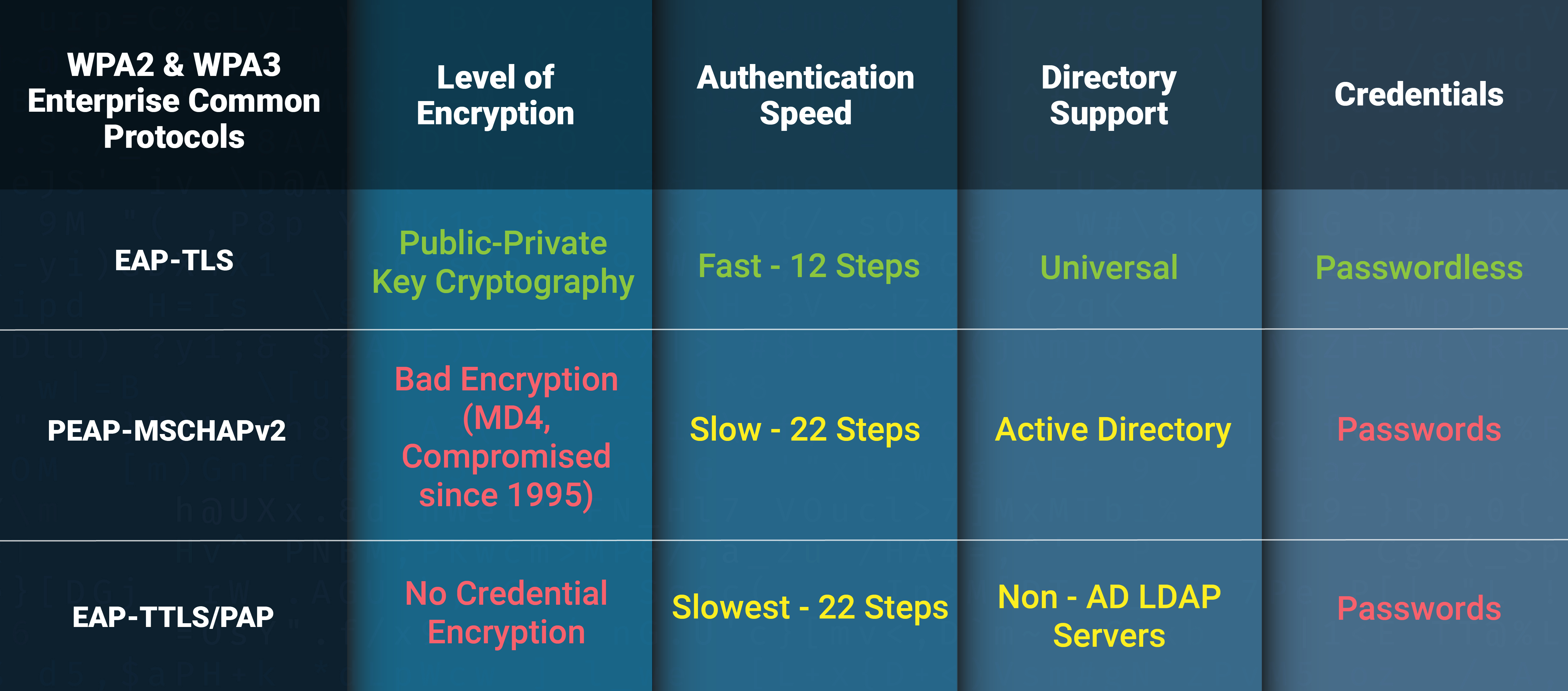
EAP-TLS (Transport Layer Security) is the gold standard of EAP protocols. It is the most secure protocol because it not only uses the EAP tunnel to encrypt traffic, but also requires both the server and the client to use certificates to authenticate with each other. This mutual authentication process ensures that both parties are who they claim to be, making it incredibly difficult for hackers to impersonate either side. The coolest part is that, since both the server and the client are using certificates, the authentication process consists of signing a challenge with a private key and having the other party validate the signature with the public key in the certificate. This means there are no passwords involved and no credentials shared, so there is no risk of password compromise. That makes EAP-TLS the most secure option for protecting your network from unauthorized access and potential breaches. Since certificates can be automatically enrolled and renewed with an MDM, it also offers a seamless user experience.
What is EAP-TTLS/PAP?
EAP-TTLS (Tunneled Transport Layer Security) with PAP (Password Authentication Protocol) also uses TLS to encrypt the communication between the client and the server, but only the server is required to have a certificate. The client does not need to have a certificate, and instead, it shares its password with the server through the encrypted tunnel. Think of it as the band-aid that the security community did to patch the issue of passwords and hashes being sent unencrypted through the network. While this solves the issue of an attacker sniffing your network and stealing passwords, it still relies on passwords which is not ideal in the zero trust world. Since if users are not educated on best practices for password management, they may fall victim to phishing attacks or other social engineering tactics that can lead to credential compromise.
What’s the Difference Between EAP-TTLS/PAP vs. EAP-TLS?
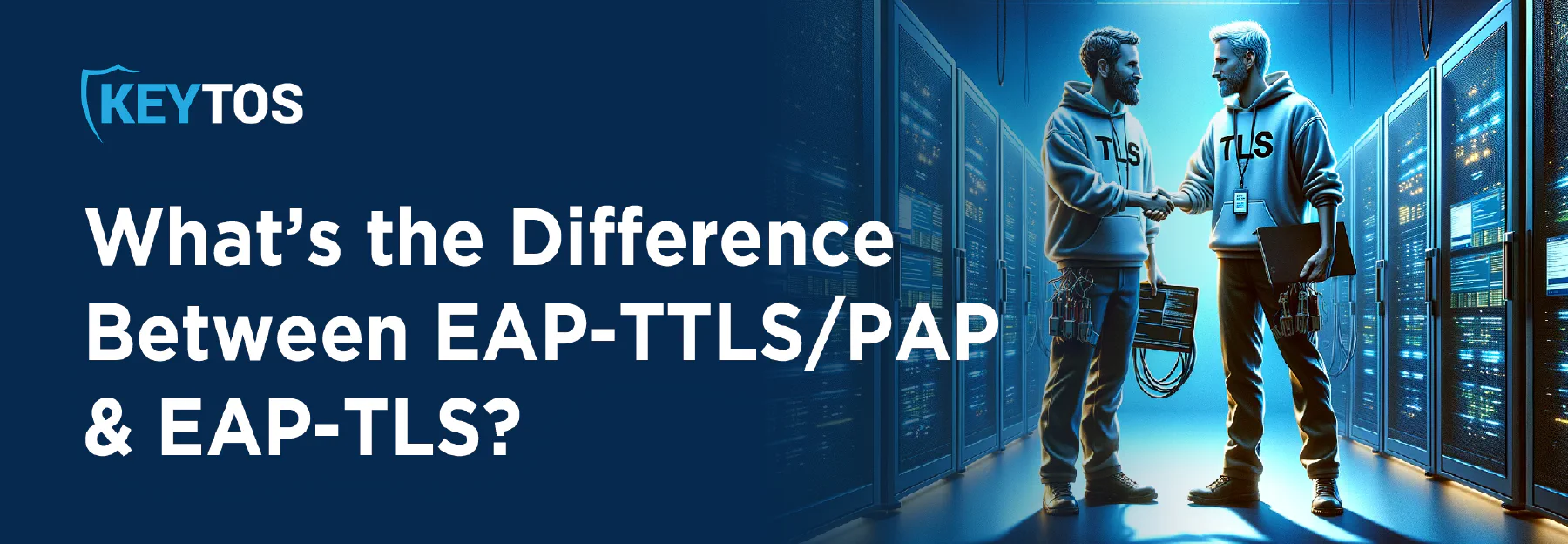
EAP-TLS is like a high-security handshake where both sides need to show ID (certificates, in this case) to trust each other. It’s like a secret club’s handshake but with digital certificates.
EAP-TTLS/PAP, on the other hand, is a bit more “relaxed”. The server still has a certificate but the client is not required to have one. Once a TLS tunnel is created, the client shares the password with the server through the tunnel. While it is more secure than regular PAP that is not encrypted, you are still relying on a password.
What are the Advantages of EAP-TLS?
EAP-TLS is like the Fort Knox of authentication. It uses sophisticated digital certificates instead of simple passwords, making it a tough nut to crack for any would-be intruders. It’s faster, more secure, and can be automated with an MDM (you automatically create the certificate, and set the wifi profile to use the certificate. No interaction from the user). In the battle against cyber baddies, moving away from passwords to something like EAP-TLS can be a game-changer. It’s not just about locking doors; it’s about making sure those doors are as strong as they can possibly be.
What are the Shortcomings of EAP-TTLS/PAP?
Though EAP-TTLS/PAP sounds easy-peasy, it’s got a few chinks in its armor. For starters, it still depends on passwords managed by a human, which is a no-go in a world where hackers are lurking. Here, if the user is not educated on best practices, the user can fall for a man in the middle attack, giving the credentials to an attacker.
How to Get Started with EAP-TLS
Keytos is your ally in this quest, offering everything you need to transition to a certificate-based authentication with EAP-TLS. We’ve got tools, support, and the know-how to make your network as secure as it can be, without making it a hassle for you or your team. So, what’s it gonna be? Stick with the old and vulnerable, or step up to the secure, sleek future with EAP-TLS? Your call, but I know where I’d put my money. Feel free to reach out to our Team of PKI Experts for a FREE assessment as to how to best move forward with EAP. DIY more your style? Head on over to the docs or view some more of our suggested reading below.